
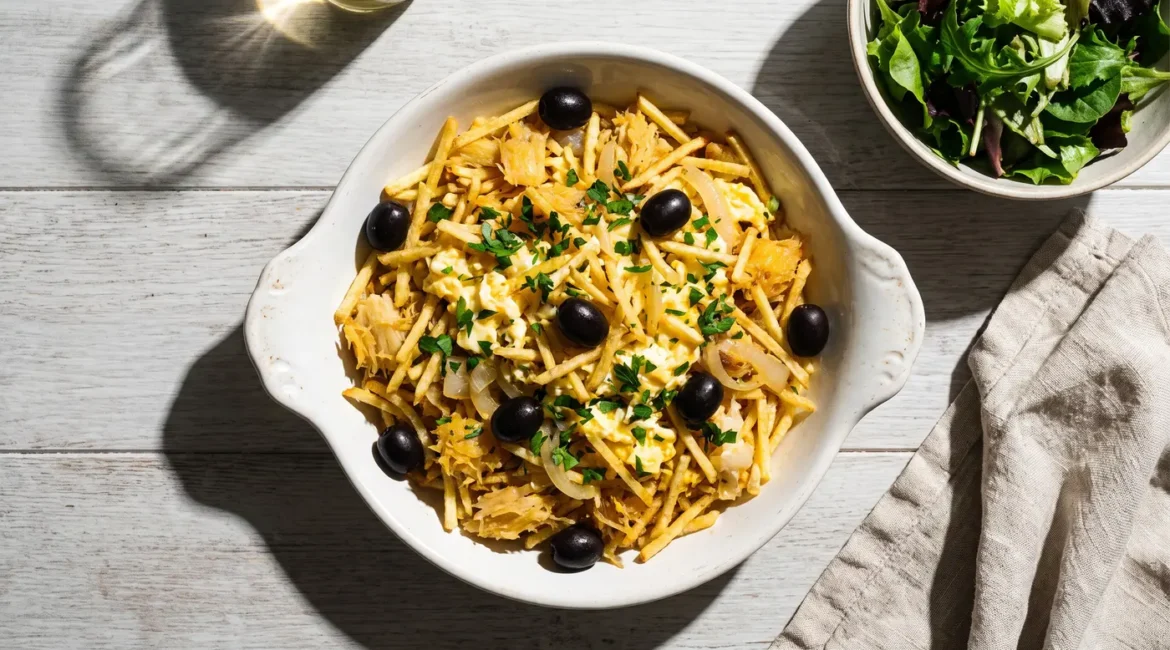
Some dishes you learn from a book. Bacalhau à Brás you learn in a Portuguese kitchen, watching someone move the pan at exactly the right moment. This article puts it on paper, with help from someone who has seen cod come out of the sea, on the cold fishing banks off Canada, long before it ever reached a plate.
The result is simple: shredded salt cod, matchstick potatoes, onion and egg. Four ingredients that, handled well, make one of the most comforting dishes in Portuguese cooking. Handled badly, they make a dry mash. The difference is in the details below.
Where Bacalhau à Brás comes from
Tradition says the dish was born in Bairro Alto, in Lisbon, created by a tavern keeper named Brás. There are no records to prove it, but the story makes sense: this is tavern food, made from leftover cod and potatoes, quick and cheap. Today it is on almost every menu in Portugal.
Ingredients (serves 4)
- 400 g salt cod, already desalted (loin or thick fillet)
- 300 g matchstick potatoes (homemade or good quality store-bought)
- 2 medium onions
- 3 garlic cloves
- 6 eggs
- 6 tablespoons olive oil
- Fresh parsley, chopped
- Black olives
- Freshly ground black pepper
- Salt, only if needed
Step one: desalt the cod properly
Dried salt cod has to lose its salt before it goes near the heat. Place it in cold water, skin side up, in the fridge. Change the water three to four times a day.
- Thin pieces: about 24 hours
- Thick pieces and loins: 36 to 48 hours
To check if it is ready, taste a small raw flake from the centre. It should taste of the sea, not of salt. If you live outside Portugal, look for frozen cod that is already desalted. It saves two days and the result is very good.
How to make it
- Remove the skin and bones from the cod and shred it by hand into thin flakes. Do not boil it first: it will cook in the pan.
- Slice the onions into very thin half-moons and chop the garlic.
- In a wide frying pan, heat the olive oil over medium heat. Add the onion and garlic and cook slowly for about 10 minutes, until the onion is soft and translucent.
- Add the shredded cod and stir for 3 to 4 minutes, so it soaks up the oil and the flavour of the onion.
- Add the matchstick potatoes and fold them in gently.
- Lower the heat. Beat the eggs with pepper and pour them over the mixture.
- Stir constantly and take the pan off the heat while the eggs are still creamy and glossy. This is the moment that defines the dish.
- Taste, add salt only if needed, sprinkle with parsley and finish with black olives. Serve straight away.
The secret: the egg must stay creamy
A good Bacalhau à Brás is not an omelette. The egg should coat the cod and potatoes like a light sauce. The heat of the pan keeps cooking after you turn it off, so take it off a little before the texture you want.
Mistakes that ruin the dish
- Cod not desalted enough: it stays salty and there is no way to fix it afterwards.
- Heat too high at the end: the egg dries out and the dish turns grainy.
- Potatoes added too early: they go soft and lose their crunch. Add them just before the eggs.
- Salting without tasting: the cod and the potatoes already carry salt.
What to serve with it
A simple green salad with red onion and a drizzle of olive oil balances the dish. To drink, a crisp white wine or sparkling water with lemon.
Frequently asked questions
Can I use fresh cod? You can, but the flavour changes a lot. Dried, cured cod has a deeper taste, and that is what defines the dish.
Can I make it ahead? It is not ideal. The egg loses its creaminess when reheated. You can prepare the onion and cod in advance and add the potatoes and eggs just before serving.
What is the difference from Bacalhau à Gomes de Sá? Gomes de Sá is baked in the oven, with sliced boiled potatoes and hard-boiled egg. Brás is made in the pan, with matchstick potatoes and creamy egg.
Bring the sea to your table
Bacalhau à Brás is just one of the recipes that show how a meal can taste of the coast, even far away from it. If you want to go further, the Coastal Culinary Journey guide takes you along four coasts of the world, each with its own dish and its own ritual at the table. Discover the guide here.
